Graduate School of Social Innovation (Professional)
News
MBA programs that cultivate social innovators
Starting from their own sense of unease and awareness of problems, we cultivate individuals who can not solve social issues symptomatically, but rather formulate questions from their own perspective, analyze the root causes, deepen their understanding of those questions, and, in collaboration with people from diverse fields such as corporations, government, and NPOs, creatively plan and implement community-based projects and policies as active participants.
Message from the Dean of the Graduate School
Nurturing social innovators who contribute to building a sustainable society.
The global environment is changing dramatically due to diverse social issues such as climate change and technological innovation. In this situation, societies and businesses need to go far beyond simply extending their past experiences and acquire new knowledge and ways of thinking. To address this situation, our university has established a professional graduate school aimed at nurturing social innovators who will contribute to building a sustainable society.
This graduate school has four distinctive features that correspond to the process of creating innovation. First, it includes thinking-based courses that help students recognize and reconstruct their own thinking frameworks, which are essential for generating innovative ideas. Second, it includes management-related courses that involve acquiring and creating the knowledge required for implementing innovation. Third, it offers small-group seminars where students learn communication skills and practical abilities required in the process of implementing innovation, together with faculty members who are practitioners and their peers. Fourth, it has a diverse group of peers who support the construction of public-private partnerships and other networks necessary for the practice of Regional innovation. Students will utilize these resources to produce research papers that encompass theory and practical plans, and become agents of social change.
Let's move beyond clichés like rationality, efficiency, ease of understanding for everyone, and results being everything, and instead critically examine business in order to explore a sustainable society. Together, let's consider the business models, innovations, and regional development that will truly be needed in the future.
This graduate school has four distinctive features that correspond to the process of creating innovation. First, it includes thinking-based courses that help students recognize and reconstruct their own thinking frameworks, which are essential for generating innovative ideas. Second, it includes management-related courses that involve acquiring and creating the knowledge required for implementing innovation. Third, it offers small-group seminars where students learn communication skills and practical abilities required in the process of implementing innovation, together with faculty members who are practitioners and their peers. Fourth, it has a diverse group of peers who support the construction of public-private partnerships and other networks necessary for the practice of Regional innovation. Students will utilize these resources to produce research papers that encompass theory and practical plans, and become agents of social change.
Let's move beyond clichés like rationality, efficiency, ease of understanding for everyone, and results being everything, and instead critically examine business in order to explore a sustainable society. Together, let's consider the business models, innovations, and regional development that will truly be needed in the future.
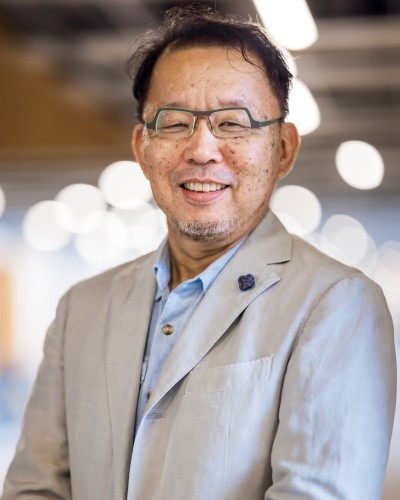
Dean of the Graduate School of Social Innovation
Professor Ohmuro Nobuyoshi
Characteristics of the Graduate School of Social Innovation
We have set up curriculum models to cultivate the leaders that Nagano Prefecture needs, including the "Entrepreneur" model, which allows students aspiring to start their own businesses or intrapreneurship to experience the entire process from knowledge creation and business model development to commercialization, and the "Public-Private Partnership Promotion Personnel" model, which allows students aspiring to public-private partnerships to learn the entire process of basic business and experience the process of formulating and implementing policies together with local actors.
Furthermore, to make it easier for students to attend while working, lectures are held on Monday through Thursday evenings (online) and on Saturdays (alternating between in-person and online). In particular, first-year students are required to come to Miwa Campus in Nagano City every other Saturday, but even students from far away look forward to attending and participating in face-to-face discussions.
Furthermore, to make it easier for students to attend while working, lectures are held on Monday through Thursday evenings (online) and on Saturdays (alternating between in-person and online). In particular, first-year students are required to come to Miwa Campus in Nagano City every other Saturday, but even students from far away look forward to attending and participating in face-to-face discussions.
From philosophical thinking, art thinking, and other thinking subjects that involve confronting one's own senses
Developing the ability to question and engage with society from one's own perspective, taught by experienced instructors who have been involved in entrepreneurship, new business development, and strategic planning support.
Develop practical skills through small-group lectures and seminars.
Developing the ability to question and engage with society from one's own perspective, taught by experienced instructors who have been involved in entrepreneurship, new business development, and strategic planning support.
Develop practical skills through small-group lectures and seminars.
We deepen our learning in foundational and specialized subjects, and engage in discussions with peers who are pursuing careers as social innovators.
Acquire the knowledge and skills to deepen your understanding of the questions. This is due to the presence of students with diverse ages, affiliations, and backgrounds.
Meeting people who support and encourage community-based practices
Acquire the knowledge and skills to deepen your understanding of the questions. This is due to the presence of students with diverse ages, affiliations, and backgrounds.
Meeting people who support and encourage community-based practices
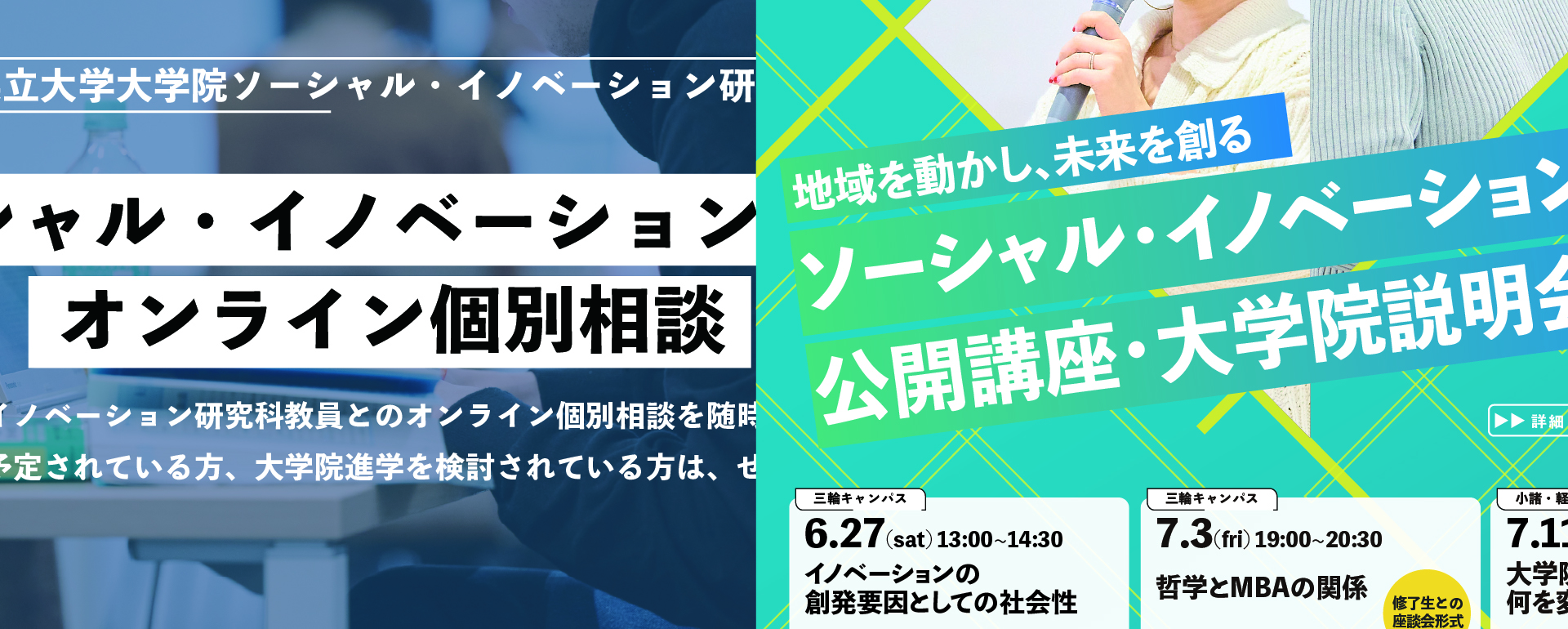
We are currently holding public lectures, graduate school information sessions, and online individual consultations!
The Graduate School of Social Innovation is a professional graduate school that cultivates the ability to fundamentally and creatively solve social issues in collaboration with people from diverse fields such as corporations, government, and NPOs. Ambitious working professionals with diverse backgrounds gather from all over the prefecture and beyond.
To provide you with an opportunity to learn about our graduate school, we will be holding open lectures, graduate school information sessions, and individual consultations. The open lectures will allow you to experience some of the distinctive courses offered by our graduate school. We will also be accepting questions and consultations regarding admissions at the graduate school information sessions and online individual consultations. Everyone is welcome to participate, so please feel free to join us.
Click here for details
To provide you with an opportunity to learn about our graduate school, we will be holding open lectures, graduate school information sessions, and individual consultations. The open lectures will allow you to experience some of the distinctive courses offered by our graduate school. We will also be accepting questions and consultations regarding admissions at the graduate school information sessions and online individual consultations. Everyone is welcome to participate, so please feel free to join us.
Click here for details
Overview of the Graduate School of Social Innovation
| Graduate school name | Graduate School of Social Innovation (Professional Graduate School) |
| Major | Social Innovation Major |
| course | Professional degree programs (MBA programs) |
| Types of degrees | Master of Business Administration (Professional) |
| Standard study period | 2 years |
| Number of credits required for completion | 40 units |
| Enrollment capacity | 10 people |