Department of Food and Health Sciences
We aim to deepen our understanding of nutrition and eating habits for people at various life stages, learn how registered dietitians play an active role, and become "health professionals through food."
While improving our English skills, we will also share with the world the richness of Nagano Prefecture's food culture and the health and longevity it promotes.
Furthermore, we aim to improve people's quality of life (QOL) and contribute to society by putting our knowledge into practice through a variety of experiments and practical training.
While improving our English skills, we will also share with the world the richness of Nagano Prefecture's food culture and the health and longevity it promotes.
Furthermore, we aim to improve people's quality of life (QOL) and contribute to society by putting our knowledge into practice through a variety of experiments and practical training.

Qualifications and licenses that can be obtained
Registered Dietitian (Eligibility to take the national examination)
Registered Dietitian License
Nutrition Teacher's License (Type 1)
Food hygiene manager and food hygiene inspector (qualification for appointment) *
Skills you will acquire in four years
1. Practical skills based on scientific evidence
The world of food and health is overflowing with both true and false information. Registered dietitians need to be able to judge "how much of this is true and how much is false" based on evidence (a "science" perspective). They will acquire the practical skills to provide appropriate nutritional management to their clients and to conduct evidence-based nutrition education and guidance.
2. Communication skills that are attentive to the needs of the target audience.
We work with people of all ages, carefully observing each individual, building relationships with them empathetically, and supporting them in changing their eating habits to be more desirable. While acquiring the fundamental theories of counseling and coaching, we enhance our communication skills and creativity ("artistic" perspective) through role-playing and other exercises to better connect with our clients.
Student Interviews / Student's Voice
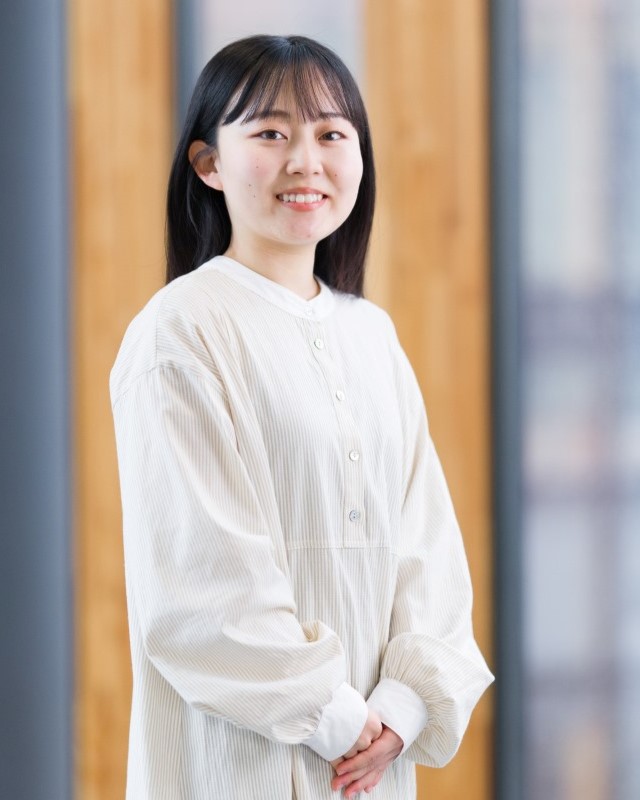
Fourth-year Department of Food and Health Sciences (at the time of the interview)
Shiho Miyahara
Learning about metabolism and the workings of the human body helped me understand how to eat properly.
The appeal of this program lies in its well-structured, step-by-step learning system for obtaining a registered dietitian qualification. After learning the fundamentals, you can solidify your learning through experiments, practical training, and exercises.
I like biology and exercise physiology. Learning about metabolism and the workings of the human body allows you to understand more efficient and effective ways of eating, which is interesting. That's what I felt. Also, because there are many clinical training opportunities (3 required subjects and 5 elective subjects), you can thoroughly learn about the realities of working as a registered dietitian in the field.
For my graduation research, I was interested in regions facing food poverty, My research focuses on the food diversity of preschool children and their mothers living in Nigeria. I want to develop the ability to read research papers and analyze issues based on scientific evidence. Going forward, I want to stay informed about food information not only in Japan but also overseas, and maintain a broad perspective.
I like biology and exercise physiology. Learning about metabolism and the workings of the human body allows you to understand more efficient and effective ways of eating, which is interesting. That's what I felt. Also, because there are many clinical training opportunities (3 required subjects and 5 elective subjects), you can thoroughly learn about the realities of working as a registered dietitian in the field.
For my graduation research, I was interested in regions facing food poverty, My research focuses on the food diversity of preschool children and their mothers living in Nigeria. I want to develop the ability to read research papers and analyze issues based on scientific evidence. Going forward, I want to stay informed about food information not only in Japan but also overseas, and maintain a broad perspective.
Department of Food and Health Sciences Q&A
What is the pass rate for the national examination for registered dietitians?
→In the 2022 academic year exam, our university had a pass rate of 96.7%. The national pass rate was 65.1% (including graduates).
Is the national exam difficult? Is there any support available for preparing for the national exam?
→Passing the national examination is not easy without preparation. Our university has set up a curriculum that conforms to the national examination standards (guidelines) for registered dietitians, and each subject is taught with the national examination in mind.
In addition, as for specific national examination preparation, we implement systematic measures such as mock exams and self-study plan support for about a year starting around January of the third year, and we also provide one-on-one support based on the results of the mock exams.
I'm a humanities student; can I get into Department of Food and Health Sciences? Also, will I have difficulties after I get in?
→Entrance exams (science section) can be taken with basic biology and basic chemistry. Therefore, it's okay even if you have a humanities background up to high school.
After enrollment, you can take lectures in subjects such as chemistry and biology (life sciences), allowing you to thoroughly review the material. Furthermore, the instructors for each lecture will conduct their classes carefully to ensure a deep understanding.
What kinds of internship sites are available?
→Internship opportunities are available at public health centers, school lunch facilities, and hospitals in Nagano Prefecture, as well as at catering companies, elderly care facilities, and daycare centers.
I find your university's emphasis on English appealing, but I've heard that the curriculum for Department of Food and Health Sciences is quite demanding from the first year, and I'm worried about whether I'll be able to keep up with the English.
→Indeed, our university places a strong emphasis on English education, and in the first year, there are English lectures almost every day.
It might be a little tough if you're not good at English. However, we place students into classes based on their level after an initial test, so I don't think you'll have any trouble earning credits. Also, by taking English lectures every day, you should be able to gradually overcome your weaknesses.
→And the curriculum for first-year students in Department of Food and Health Sciences often includes a solid 5th period.
The curriculum mainly consists of foundational subjects. Each lecturer conducts their classes thoroughly and carefully to ensure a deep understanding. Senior students manage their time effectively, and everyone earns the necessary credits to advance to the next year.
→In the 2022 academic year exam, our university had a pass rate of 96.7%. The national pass rate was 65.1% (including graduates).
Is the national exam difficult? Is there any support available for preparing for the national exam?
→Passing the national examination is not easy without preparation. Our university has set up a curriculum that conforms to the national examination standards (guidelines) for registered dietitians, and each subject is taught with the national examination in mind.
In addition, as for specific national examination preparation, we implement systematic measures such as mock exams and self-study plan support for about a year starting around January of the third year, and we also provide one-on-one support based on the results of the mock exams.
I'm a humanities student; can I get into Department of Food and Health Sciences? Also, will I have difficulties after I get in?
→Entrance exams (science section) can be taken with basic biology and basic chemistry. Therefore, it's okay even if you have a humanities background up to high school.
After enrollment, you can take lectures in subjects such as chemistry and biology (life sciences), allowing you to thoroughly review the material. Furthermore, the instructors for each lecture will conduct their classes carefully to ensure a deep understanding.
What kinds of internship sites are available?
→Internship opportunities are available at public health centers, school lunch facilities, and hospitals in Nagano Prefecture, as well as at catering companies, elderly care facilities, and daycare centers.
I find your university's emphasis on English appealing, but I've heard that the curriculum for Department of Food and Health Sciences is quite demanding from the first year, and I'm worried about whether I'll be able to keep up with the English.
→Indeed, our university places a strong emphasis on English education, and in the first year, there are English lectures almost every day.
It might be a little tough if you're not good at English. However, we place students into classes based on their level after an initial test, so I don't think you'll have any trouble earning credits. Also, by taking English lectures every day, you should be able to gradually overcome your weaknesses.
→And the curriculum for first-year students in Department of Food and Health Sciences often includes a solid 5th period.
The curriculum mainly consists of foundational subjects. Each lecturer conducts their classes thoroughly and carefully to ensure a deep understanding. Senior students manage their time effectively, and everyone earns the necessary credits to advance to the next year.
Department Introduction
This is a departmental introduction from our open campus event. It was created by students in Department of Food and Health Sciences.
The book also includes photos of actual classes and Overseas Program. Please take a look.
The book also includes photos of actual classes and Overseas Program. Please take a look.
We are currently streaming videos of departmental guidance sessions and mini-lectures from our open campus events on YouTube.
We have also uploaded videos of other mini lectures, so please check out our YouTube channel.
In addition to open campus events, YumeNavi also offers many lecture videos, such as "Improving Your Diet with 'Plus 1' - A Case Study from Nigeria."
Click here for The University of Nagano 's Dream Navi.
Click here for The University of Nagano 's Dream Navi.